
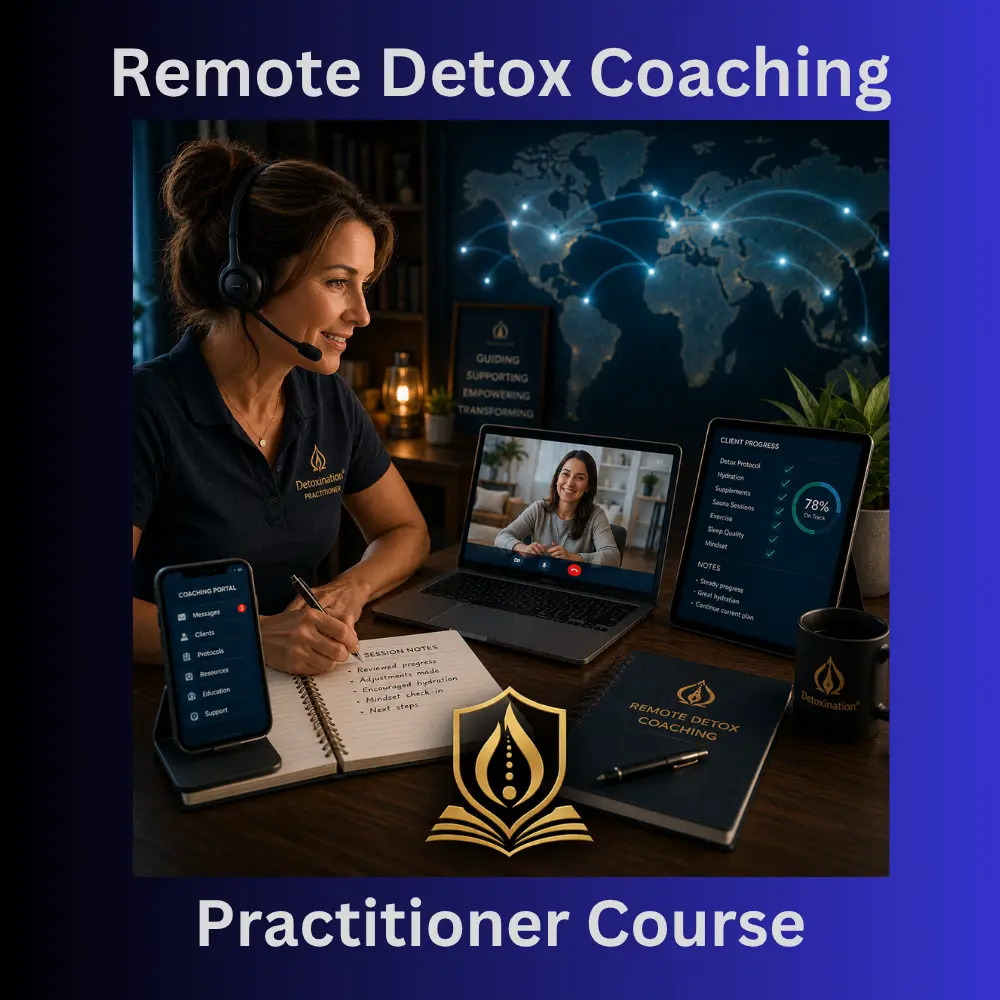
Remote Detoxination® Coaching
Course Overview
The Remote Detoxination® Coaching course prepares practitioners to guide individuals through the Detoxination® Method when in-person supervision is impractical or unavailable.
Remote implementation requires more than communicating by telephone, email, or video conference. It requires a structured coaching system, careful screening, clear expectations, reliable documentation, consistent follow-up, and a thorough understanding of the Detoxination® Method.
This course examines the professional procedures and practical considerations involved in providing remote educational guidance throughout the preparation, implementation, monitoring, and completion phases of a Detoxination® program.
Particular attention is given to the responsibilities that arise when the practitioner and participant are not physically present in the same location. Participants will learn how to establish appropriate communication procedures, monitor progress, identify concerns, document relevant developments, and determine when modification, postponement, referral, or additional professional support may be necessary.
Course Philosophy
Effective remote coaching is based upon education, preparation, communication, accountability, and ongoing assessment. It is not simply a matter of providing written instructions and expecting an individual to complete the program independently.
The remote coach helps the participant understand the purpose and sequence of the protocol, prepare the necessary environment and supplies, recognize expected responses, report meaningful changes, and remain engaged throughout the process.
The course emphasizes a participant-centered approach in which implementation is adapted to the individual’s readiness, health history, tolerance, available resources, support system, and professional care needs.
Remote Detoxination® Coaching is presented as a structured educational and supportive service. It does not replace medical diagnosis, treatment, emergency care, or the ongoing management provided by appropriately qualified healthcare professionals.
Relationship to Practitioner Training
Remote Detoxination® Coaching builds upon the scientific, safety, and implementation principles taught in the Academy’s practitioner curriculum.
Participants should have a working knowledge of thermotherapy implementation and the complete Detoxination® Method before assuming responsibility for guiding another person remotely.
Completion of Practitioner Detoxination® Implementation, or equivalent education and experience accepted by the Detoxination® Academy, is strongly recommended before beginning this course.
Remote coaching does not reduce the need for professional judgment. The physical distance between practitioner and participant increases the importance of appropriate screening, advance preparation, communication planning, documentation, and clearly defined escalation procedures.
Intended Audience
This course is intended for professionals who wish to provide structured educational guidance and ongoing support to individuals implementing the Detoxination® Method outside an in-person practice setting.
Appropriate participants may include:
- Graduates of Practitioner Detoxination® Implementation
- Licensed healthcare professionals
- Qualified wellness practitioners
- Health and wellness coaches
- Detoxination® practitioners expanding into remote service delivery
- Practitioners supporting individuals who do not have access to trained local supervision
- Professionals responsible for coordinating participant education, preparation, monitoring, and follow-up
Participation in this course does not expand a person’s legal scope of practice. Each practitioner remains responsible for understanding and following the laws, regulations, ethical standards, and professional limitations applicable to their location and credentials.
Course Objectives
Upon completion of the course, participants should be able to:
- Explain the professional role and limitations of a Remote Detoxination® Coach.
- Describe how remote coaching differs from in-person protocol supervision.
- Establish a structured remote consultation and onboarding process.
- Review the Detox Readiness Assessment and relevant health-history information before implementation.
- Determine whether an individual appears appropriately prepared for remote participation.
- Identify circumstances that may require postponement, modification, additional support, or healthcare-provider involvement.
- Help participants prepare the required supplies, equipment, environment, schedule, and support system.
- Communicate protocol instructions in a clear, organized, and understandable manner.
- Develop individualized implementation and communication plans within the established protocol framework.
- Monitor participant progress through scheduled reporting and follow-up procedures.
- Recognize common implementation challenges and apply appropriate troubleshooting strategies.
- Distinguish expected protocol responses from developments requiring additional evaluation.
- Document consultations, progress reports, modifications, concerns, and recommendations appropriately.
- Maintain professional boundaries and protect participant privacy during remote communications.
- Recognize circumstances requiring referral to emergency services, medical care, or another qualified professional.
- Support participant education, accountability, confidence, and informed decision-making throughout the program.
Core Areas of Study
The course addresses the principal systems and responsibilities involved in remote protocol delivery, including:
- Remote-service readiness and professional preparation
- Participant screening and intake procedures
- Review of the Detox Readiness Assessment
- Health-history review and risk identification
- Informed participation and expectation setting
- Technology, scheduling, and communication procedures
- Equipment, sauna, supplement, and supply verification
- Pre-program preparation and participant education
- Individualized pacing and implementation planning
- Daily and weekly reporting systems
- Progress monitoring and documentation
- Common implementation challenges
- Protocol modification and escalation procedures
- Healthcare-provider collaboration and referral
- Program completion and post-program follow-up
- Professional boundaries, ethics, and scope of practice
The Responsibilities of the Remote Coach
The remote coach serves as an educator, organizer, observer, and source of structured support. The coach helps the participant understand and follow the established program while monitoring the information provided through scheduled communications.
This role requires consistency, attention to detail, professional judgment, and the willingness to slow, modify, postpone, or discontinue implementation when circumstances indicate that continued participation may not be appropriate.
Responsibilities may include:
- Confirming that required screening and preparation have been completed
- Reviewing participant questions and expectations before the program begins
- Verifying access to an appropriate sauna and exercise environment
- Confirming that required nutritional supports and toxin binders are available
- Establishing a reliable schedule for consultations and progress reporting
- Providing clear instructions without exceeding professional scope
- Monitoring adherence, tolerance, hydration, nutrition, and recovery
- Identifying patterns that may indicate the need for pacing or modification
- Maintaining timely and accurate coaching records
- Recognizing when another qualified professional should become involved
Screening and Readiness
Remote participation begins with determining whether the individual is reasonably prepared to undertake the program without continuous in-person supervision.
The Detox Readiness Assessment provides an initial educational and screening framework. It helps identify potential preclusions, contraindications, health-history considerations, support needs, and circumstances in which professional guidance may be particularly important.
The DRA does not replace professional judgment or medical evaluation. Information disclosed through the DRA, health-history questionnaire, consultation, or subsequent communication must be reviewed in the context of the coach’s qualifications and the participant’s broader care needs.
Individuals with complex health histories, multiple overlapping concerns, unstable conditions, limited physical capacity, inadequate support, or uncertainty regarding sauna tolerance may require additional evaluation or a more closely supervised implementation setting.
Communication and Monitoring
Reliable communication is one of the central safety systems of remote coaching. Expectations should be established before implementation begins, including how often the participant will report, which information should be documented, and what developments require immediate communication.
Depending upon the individual and the stage of the program, communication may include scheduled video consultations, telephone calls, secure messages, daily progress reports, workbook entries, symptom tracking, or other structured reporting methods.
Monitoring should focus on meaningful patterns rather than isolated observations. The remote coach should review information related to protocol adherence, sauna tolerance, exercise capacity, nutrition, hydration, sleep, recovery, bowel regularity, participant concerns, and other relevant developments.
The purpose of monitoring is not to diagnose the cause of every symptom. It is to determine whether implementation appears to be proceeding as expected, whether pacing or additional support may be needed, and whether the participant should seek evaluation from an appropriate healthcare professional.
Scope of Practice
Remote Detoxination® Coaching is an educational and supportive service. It does not authorize participants to diagnose illness, prescribe medical treatment, alter prescribed medications, interpret medical findings beyond their qualifications, or represent coaching as a substitute for licensed healthcare.
Practitioners must remain within the scope permitted by their education, licensure, certification, professional role, and applicable laws. The same course may therefore be used differently by a physician, nurse, chiropractor, health coach, wellness practitioner, or nonclinical educator.
When a participant’s questions or circumstances extend beyond the coach’s professional role, the appropriate response is to acknowledge that limitation and recommend consultation with a suitably qualified healthcare professional.
Responsible remote coaching includes knowing when not to proceed and when remote delivery is not the appropriate setting.
Medical and Emergency Care
Remote coaching is not an emergency-response service. Participants should be instructed to contact local emergency services when urgent or potentially serious symptoms occur.
The remote coach should know the participant’s physical location during scheduled sessions when appropriate and should maintain clearly defined procedures for situations involving loss of communication, acute distress, injury, severe heat intolerance, altered consciousness, chest pain, breathing difficulty, or other urgent concerns.
A remote coach should never attempt to manage a medical emergency through messaging, email, or routine coaching procedures.
Documentation and Privacy
Remote coaching requires accurate and organized documentation. Records should identify the information reviewed, education provided, participant reports, relevant observations, modifications discussed, referrals recommended, and follow-up arrangements.
Documentation should be factual, timely, professional, and appropriate to the practitioner’s role. It should distinguish between information reported by the participant, observations made by the coach, and recommendations provided.
Practitioners are responsible for selecting communication and recordkeeping systems appropriate to their legal and professional obligations. Personal health information should not be transmitted casually or stored through unsecured methods merely because the coaching relationship is remote.
Professional Responsibility
Effective remote coaching depends upon ethical conduct, appropriate boundaries, clear communication, accurate representation of qualifications, and a willingness to place participant safety ahead of schedule or program completion.
Practitioners should avoid guarantees, exaggerated claims, pressure-based communication, or representations that Detoxination® diagnoses, treats, cures, or prevents disease.
Participants should receive realistic information about the time commitment, preparation requirements, physical demands, potential discomforts, expected variability, and limitations of remote support before deciding to proceed.
The coach is also responsible for maintaining personal availability and workload limits that allow participant communications to be reviewed and addressed appropriately. A remote service should not accept more participants than can be supported responsibly.
Preparing for Success
Participants will receive the greatest benefit from this course when they begin with a working understanding of the complete Detoxination® Method and the professional implementation principles taught throughout the Detoxination® Academy curriculum.
Before beginning the course, learners should be prepared to:
- Review the current Detoxination® Protocol Guidebook
- Understand the role of the Detox Readiness Assessment
- Recognize the sequence and purpose of the protocol components
- Understand basic thermotherapy implementation and sauna safety
- Maintain appropriate professional records
- Use reliable video, telephone, messaging, and scheduling systems
- Establish clear communication and availability policies
- Identify local and professional referral resources
- Remain within the boundaries of their professional role
Learners are encouraged to approach the course as the development of a professional service system rather than simply the study of coaching conversations.
Applying What You Learn
Completion of the Remote Detoxination® Coaching course indicates that the learner has studied the Academy’s framework for remote implementation. It does not replace professional licensure, authorize activities outside an existing scope of practice, or guarantee suitability for every participant or circumstance.
Responsible practice requires continued study, appropriate consultation, accurate documentation, familiarity with current Academy materials, and the willingness to refine procedures as research, technology, professional standards, and the Detoxination® Method continue to develop.
The purpose of this course is to provide a structured foundation for delivering remote coaching in a manner that is organized, participant-centered, professionally responsible, and consistent with the educational standards of the Detoxination® Academy.
Copyright & Intellectual Property
© 2026 Detoxination® Academy. All Rights Reserved.
The Remote Detoxination® Coaching course—including its lessons, figures, illustrations, videos, downloadable resources, assessments, quizzes, templates, forms, and supporting instructional materials—is protected by United States and international copyright laws.
Enrollment grants each learner a personal, limited, non-transferable license to access the course materials for individual education and authorized professional reference.
Reproduction, redistribution, public presentation, recording, sharing, publication, modification, resale, sublicensing, course duplication, or commercial use of any portion of these materials without prior written permission from the Detoxination® Academy is prohibited.
Course access, files, login credentials, downloadable resources, and instructional materials may not be shared with clients, employees, colleagues, organizations, social-media groups, or other third parties except where a resource is expressly identified by the Academy as suitable for participant distribution.
Detoxination® and Detoxinician® are registered trademarks of Sabre Hawk, LLC and are used under license by the Detoxination® Academy.